


Roland Garros is the “marathon of Grand Slams” and the tournament that most severely punishes bettors who ignore accumulated fatigue. In 2026, betting on the red clay of Paris requires a mathematical model radically different from those used for Australia or Wimbledon. Here, ball speed is secondary to sliding ability and aerobic endurance. Because the “Match Winner” market is often highly efficient, the real value is found in “Match Duration” and “Game Handicap” markets.
The Physics of Red Clay and the “Sun Effect”
The crushed brick surface of Roland Garros is extremely sensitive to humidity and temperature, significantly altering the “Court Pace Index” (CPI) within hours.
- Hot and Sunny Conditions: When temperatures exceed 25°C, the clay dries out and becomes faster. The bounce is higher and “kicks” more, favoring players who use heavy top-spin. In these conditions, the Over on Aces often holds value as the ball jumps higher after the serve impact.
- Humid and Overcast Conditions: If it is cloudy or humid, the clay becomes damp and the balls become “heavy.” The game slows down drastically. Big servers lose their edge, and defensive specialists (grinders) dominate. The “Over 9.5 Games in Set” market loses value as service breaks become much more frequent.
Break Point and Return Analysis
At Roland Garros, the serve is not a guarantee of winning the game. It is the tournament with the highest percentage of service breaks on the circuit.
- Service Break Markets: In 2026, data shows that even elite servers lose their serve 25% more often in Paris than on hard courts. Betting the “Over on Breaks” in matches between baseline specialists is one of the most profitable strategies.
- Negative Game Handicap (-): Since men’s matches are best-of-five, a clay specialist can lose a set but win the other three convincingly (e.g., 1-6, 6-2, 6-1, 6-0). This makes the Negative Game Handicap (-) safer for the favorite in Paris than at Wimbledon, where sets tend to be much closer in score.
Strategic Insights: ATP vs. WTA
- ATP (Men’s Draw): The key is the “Fifth Set.” In 2026, modeling distance covered is vital. A player who has spent more than 12 hours on court in the first three rounds has a 20% higher probability of losing in the fourth round, regardless of their ranking. The value lies in betting against exhausted favorites.
- WTA (Women’s Draw): While historically volatile, 2026 has seen “clay specialists” dominate. The player with the better Second Serve Points Won percentage usually wins. On clay, the second serve is attacked ruthlessly; if a player has a weak second serve, the “Total Games: Under” market becomes attractive.
The Philippe-Chatrier Factor and the Roof
Since the installation of the retractable roof and floodlights, the tournament has changed its night-time dynamics.
- Night Sessions: The balls are much heavier at night. The game is extremely slow. Professional bettors often look for the Under on Aces in the Philippe-Chatrier night sessions.
- Indoor Effect: If the roof is closed due to rain, humidity is trapped inside. This creates a heavy atmosphere where spin is less effective. Players with flat, powerful groundstrokes gain a window of opportunity they wouldn’t have under an open sky.
Prop Markets and Sliding Metrics
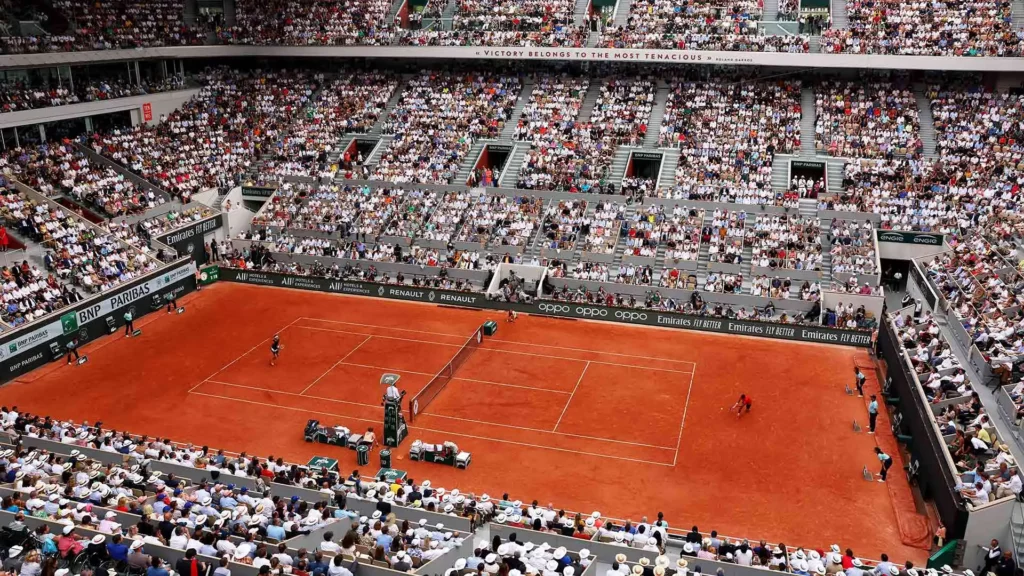
- Rally Length: At Roland Garros, rallies average over 6 shots. If a player constantly tries to shorten points (coming to the net without proper preparation), it is usually a sign of lack of confidence or fatigue. Betting on the “Next Game Winner: Receiver” is a tactical move during these moments.
- Unforced Errors: On clay, patience is a virtue. The market for “Most Unforced Errors” often punishes aggressive players who do not know how to construct a point on a slow surface.
Risk Management: The Marathon Factor
Roland Garros lasts 15 days and is physically the most demanding tournament in tennis.
- Clay Rhythm: Never bet against a player who has won or reached the final of a warm-up tournament (Monte Carlo, Madrid, Rome) based solely on ranking. “Clay rhythm” is a real psychological and technical variable.
- Retirement Rules: Blisters and muscular issues are very common in Paris. Verify if your bookmaker pays out if one set is completed or requires the full match. In a tournament of such high attrition, the “Full Match” rule is generally safer for the bettor.