


Overview
Quantum Roulette is a live dealer roulette game based on the European (single-zero) wheel, with one major upgrade: before each spin, a small set of numbers receives random multipliers. If the ball lands on one of those multiplied numbers and you placed a straight-up bet on it, your payout can be boosted. The trade-off is higher volatility: sessions often feel calmer until a multiplied hit creates a sudden “spike.”
Key facts at a glance
| Feature | What it means |
| Wheel format | European style (single zero) |
| Multiplied numbers per spin | Usually 1–5 numbers |
| Multiplier range | Depends on the table; typically high |
| Best suited for | Classic roulette fans who want big-hit moments |
| Session feel | More volatile than standard roulette |
How Quantum Roulette works
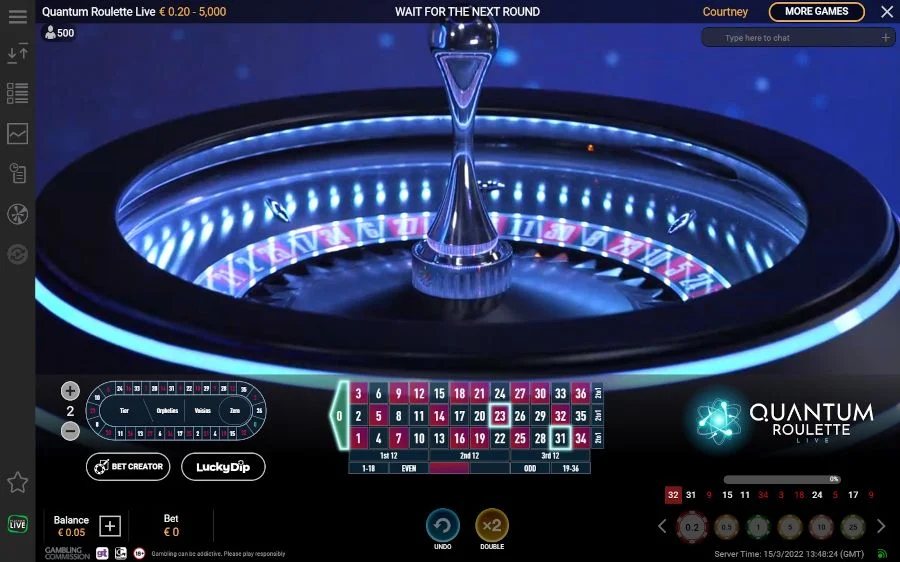
- You place bets during the betting timer (inside and/or outside bets).
- The game highlights a small set of “Quantum numbers” and assigns multipliers to them.
- The dealer spins the wheel and releases the ball.
- Payouts are settled:
- If the winning number is a multiplied number and you have a straight-up bet on it, you can receive a boosted payout.
- Other bets usually settle like standard roulette.
- If the winning number is a multiplied number and you have a straight-up bet on it, you can receive a boosted payout.
Bets you can place
Inside bets
- Straight-up (single number)
- Split (two numbers)
- Street (three numbers)
- Corner (four numbers)
- Line / Six-line (six numbers)
Outside bets
- Red / Black
- Even / Odd
- 1–18 / 19–36
- Dozens (1–12, 13–24, 25–36)
- Columns (1st, 2nd, 3rd)
Which bets the multipliers affect
| Bet type | Does the multiplier matter? | Typical outcome |
| Straight-up (single number) | Yes | Main way to land boosted wins |
| Split / Street / Corner / Line | Usually no | Settles at standard payouts |
| Outside bets | No | Settles at standard payouts |
Payout logic (simple explanation)
Quantum Roulette balances the possibility of boosted wins by adjusting the overall payout structure. In many versions, a straight-up win without a multiplier pays less than classic roulette, while a straight-up win on a multiplied number can pay much more.
What this means in practice:
- You may hit fewer “meaningful” straight-up wins without multipliers
- Big wins are possible, but not frequent
- Results swing more than classic roulette
Play styles and volatility
| Style | Typical approach | Volatility | Who it fits |
| Conservative | Mostly outside bets + 1–2 straight-ups | Low–medium | Longer sessions, steadier play |
| Balanced | Outside bets + 3–6 straight-ups | Medium | Most players |
| Aggressive | Many straight-ups, fewer outside bets | High | Big-hit seekers |
Betting mix templates
| Template | Outside bets share | Straight-ups share | Goal |
| Stability-first | 80–90% | 10–20% | Smaller swings, occasional boosts |
| Balanced | 60–75% | 25–40% | Control + multiplier chase |
| Booster-heavy | 40–55% | 45–60% | Higher spike potential |
Practical strategy
There’s no reliable way to “predict” multiplied numbers. The best strategy is managing how much you pay per spin for the chance to hit a boosted straight-up.
Recommended approach:
- Keep the majority of your stake on outside bets
- Treat straight-ups as a fixed “multiplier budget”
- Keep straight-up bet sizes consistent (no chasing)
Ways to choose straight-up numbers (structured, not predictive):
- Fixed set: pick 3–6 numbers and keep them for the session
- Sector approach: pick a cluster of neighboring numbers
- Random with limits: change picks but keep the same count and total spend
Bankroll rules that help
| Rule | Simple version | Why it matters |
| Stop-loss | “If I lose X, I stop” | Prevents chasing |
| Win goal | “If I win Y, I cash out” | Locks in spikes |
| Time cap | “I play Z minutes / N spins” | Reduces tilt |
| Fixed unit | “My base chip stays the same” | Keeps decisions rational |
Common mistakes to avoid
- Thinking “a multiplier is due” and increasing stakes
- Covering too many straight-ups each spin (cost grows fast)
- Switching strategy after one lucky hit
- Playing without money/time limits
FAQ
What is Quantum Roulette?
A live dealer roulette game where a few numbers receive random multipliers each spin, boosting straight-up wins if the ball lands on a multiplied number.
How many numbers get multipliers per round?
Usually 1–5 numbers, depending on the table configuration.
Do multipliers apply to Red/Black or Even/Odd?
Typically no. The multiplier feature mainly affects straight-up wins.
Is Quantum Roulette riskier than classic roulette?
Yes, it’s generally more volatile because big wins are concentrated in multiplied straight-up hits.
What’s a sensible way to play?
Use outside bets for stability and keep straight-ups as a smaller, fixed part of your total stake.