


Wimbledon is arguably the most atypical tournament on the tennis calendar and presents the greatest challenges for predictive algorithms. In 2026, the key to professional betting at the All England Club lies in understanding the evolution of the surface over the fortnight and the extreme brevity of the points. Here, “Game Handicaps” and “Service Markets” dominate professional activity, as grass drastically penalizes any lapse in concentration.
The Physics of Grass and Dynamic Court Pace Index (CPI)
Unlike any other surface, the grass at Wimbledon changes day by day, affecting the bounce and speed of the ball.
- Week One (Virgin Grass): During the first four days, the grass is fresh, lush, and slippery. The bounce is low and skids through the court. The CPI reaches “Very Fast” levels. This favors serve-and-volley players and those with flat groundstrokes. Bets on “Over on Aces” and “Under 1.5 breaks per set” carry high intrinsic value.
- Week Two (Worn Surface): By the quarterfinals, the baseline area is essentially bare, dry soil. The bounce becomes higher and slower, behaving more like a fast hard court. Baseline grinders begin to regain the advantage they lost in the first week. Markets often lag in adjusting to this transition, allowing for value bets on baseline specialists against pure servers in the latter rounds.
Service Markets and Tie-Break Analysis
At Wimbledon, the serve is the ultimate weapon. In 2026, modeling “First Serve Points Won Percentage” is the most reliable indicator for determining odds.
- Tie-Break Markets: Due to the difficulty of breaking serve, the “Tie-break in Match: YES” market is usually tight. However, in matchups between two Top 20 servers (e.g., Hurkacz vs. Shelton), the probability of a tie-break in the first set alone often exceeds 45%.
- Positive Game Handicap (+) for Underdogs: On grass, it is common for a favorite to win 7-6, 6-4, 7-6. Even if the favorite wins in straight sets, the underdog often covers a +4.5 or +5.5 game handicap. This is the primary capital protection strategy used by pros at Wimbledon.
Strategic Insights: ATP vs. WTA
- ATP (Men’s Draw): 5-set matches on grass are fast but mentally exhausting. 2026 statistics show that the player who wins the first set at Wimbledon goes on to win the match 82% of the time—a figure higher than any other Grand Slam. Betting on the “1st Set Winner / Match Winner” combo is a solid way to extract value from favorites.
- WTA (Women’s Draw): The women’s bracket is traditionally more volatile. Players who effectively use the backhand slice have a massive advantage, as the ball stays incredibly low. Value in 2026 is often found in grass-court specialists ranked outside the Top 30 who historically over-perform during the British swing.
External Factors: Roofs and Humidity
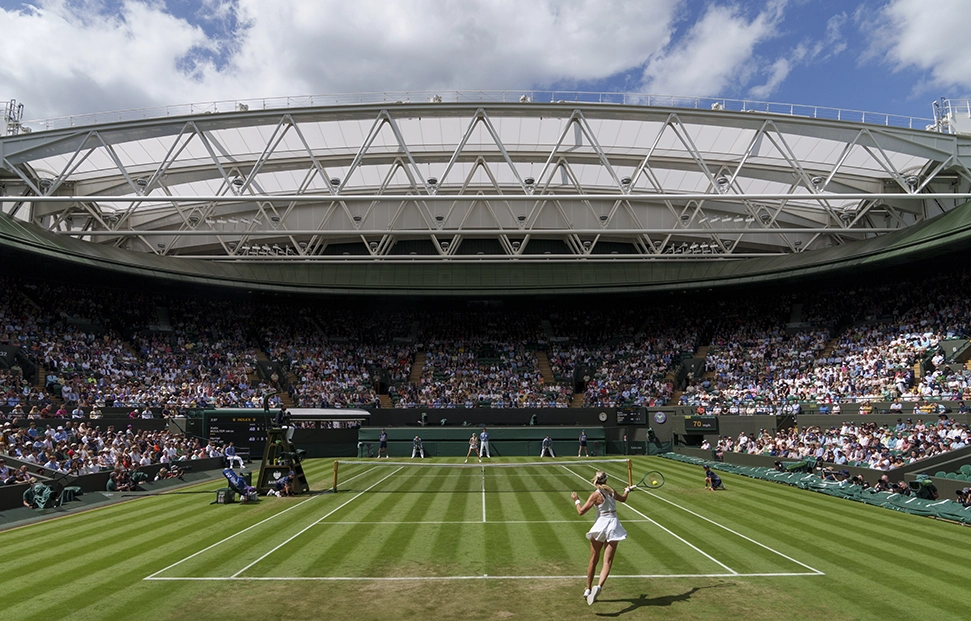
Wimbledon features retractable roofs on Centre Court and Court No. 1.
- Indoor Conditions: When the roof is closed due to rain or light, humidity increases and wind is eliminated. This benefits high-precision players with controlled power. Historically, a closed roof increases the Ace percentage per game by 11%.
- The Curfew Factor: Wimbledon has an 11:00 PM curfew. Matches suspended until the following day often see a total “momentum reset.” The player who was losing has a chance to recalibrate tactically. Betting against the player who held the momentum before the suspension is a high-risk, high-reward tactic.
Prop Markets and Grass-Court Tracking
- Net Points Won: In 2026, tracking data shows that players who come to the net more than 20 times per match have a 15% higher win probability at Wimbledon. The niche market for “Total Net Points Won” is where technical player knowledge often beats the bookmaker’s algorithm.
- Rally Length: Points at Wimbledon average fewer than 4 shots. If a match consistently sees rallies over 8 shots, it is a signal that the grass is heavily worn or the balls are “heavy,” favoring the “Under on Aces” and the baseline defender.
Risk Management: Transition and Retirements
The grass-court season is the shortest of the year (only 3-4 weeks).
- Surface Transition: Do not bet based on a player’s performance at Roland Garros. The transition from clay to grass is the hardest in tennis. Look for players who played at least one warm-up tournament (Queen’s, Halle, Eastbourne).
- Retirement Rules: Wimbledon is prone to slips and knee/ankle injuries. Ensure you use operators with a “1-Set Completed” rule (bet stands if one set is finished) or those that void entirely upon retirement, depending on your risk appetite for the specific match.